
Regulation of virulence factors and gene networks is key to understanding complex infection processes. In human-pathogenic organisms such as Candida albicans, morphological flexibility often determines disease progression. To unravel the underlying mechanisms, we support you with high-precision bioinformatic promoter analysis: from accurate identification of functional protein–DNA interactions using ChIP-seq data to computational detection and visualisation of specific binding motifs (such as the transcription factor Ahr1). This turns complex sequencing data into solid insights into cellular regulatory and feedback mechanisms.
(Status: April 2021)
Background
Candida albicans is a human-pathogenic fungus that can cause severe infections in immunocompromised patients. It grows in different forms – yeast, pseudohyphae and true hyphae – and this morphological flexibility, particularly the hyphal form, is crucial for virulence. Several virulence factors of C. albicans have been identified in recent years, many closely linked to hyphal growth. One such factor is the transcription factor Ahr1, which is thought to regulate multiple virulence-related genes by binding to their promoter regions.
Chromatin immunoprecipitation sequencing (ChIP-seq)
Two C. albicans strains with a hyperactive Ahr1 variant were analysed using ChIP-seq, a method that maps protein–DNA interactions genome-wide. In ChIP-seq, the protein is cross-linked to DNA, the DNA is fragmented and unbound fragments are removed; the protein–DNA complexes are then immunoprecipitated, the protein is removed and the remaining DNA fragments are sequenced at high throughput. In this case, the analysis yielded 325 sequence regions representing potential Ahr1 binding sites in the C. albicans genome.
Using their chromosomal positions, 532 genes on both strands were identified whose promoter regions contain these sequences and are therefore potential Ahr1 targets.
Promoter analysis
For each peak, a 500-bp region around the maximum signal (the position with the highest read coverage, and thus the most likely binding site) was extracted and used as input for the online tool MEME-ChIP (v. 5.1.0).[5] This yielded a highly significant motif matching the previously known Ahr1 binding motif. To further validate this motif, the software MochiView (v. 1.46) was used, whose integrated motif-finder also detected the known Ahr1 motif in the peak regions (Figure 1).[6]
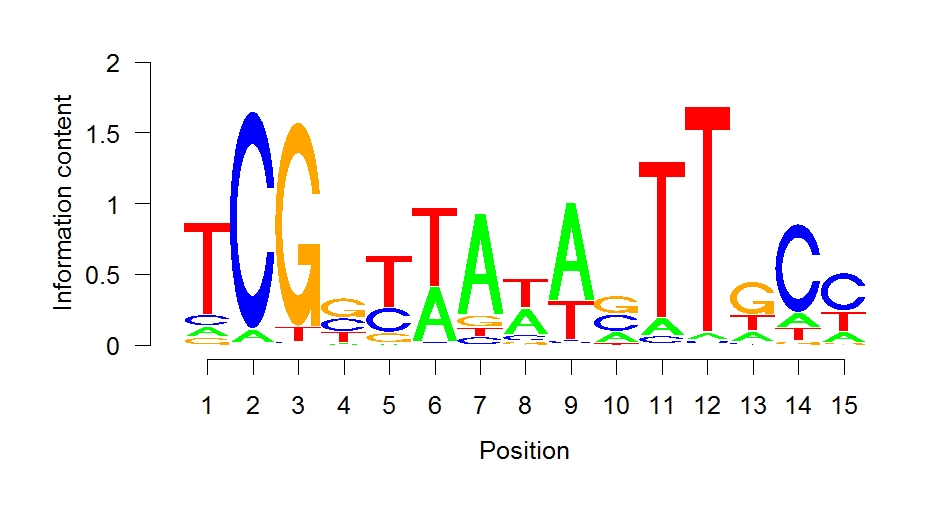
MochiView can also visualise peaks, genes and motifs together, clearly showing (Figures 2a and 2b) that Ahr1 binds in the promoter regions of key virulence-associated genes such as ECE1 and ALS3 in C. albicans. Often, multiple potential binding sites per promoter region are present.
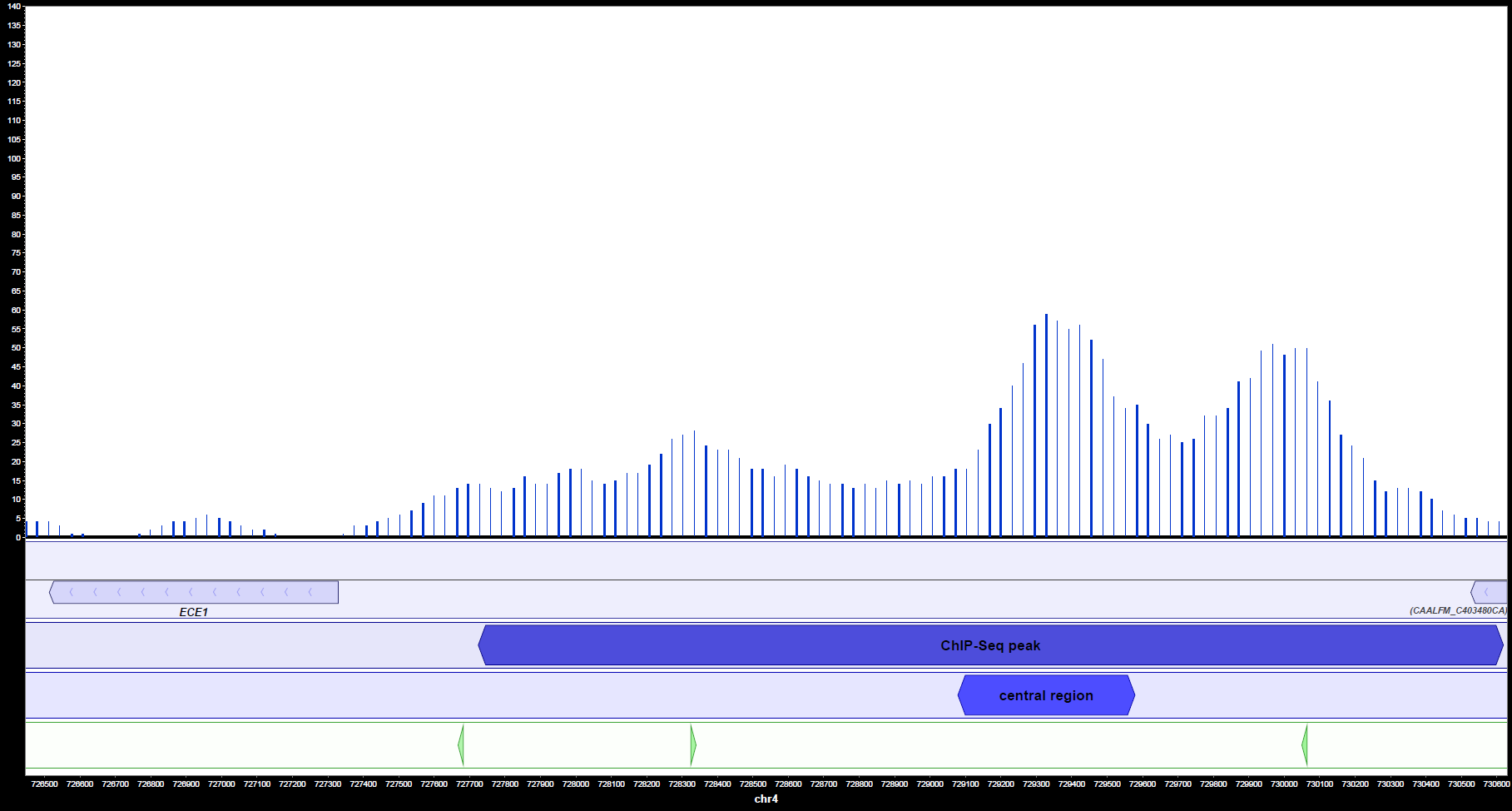
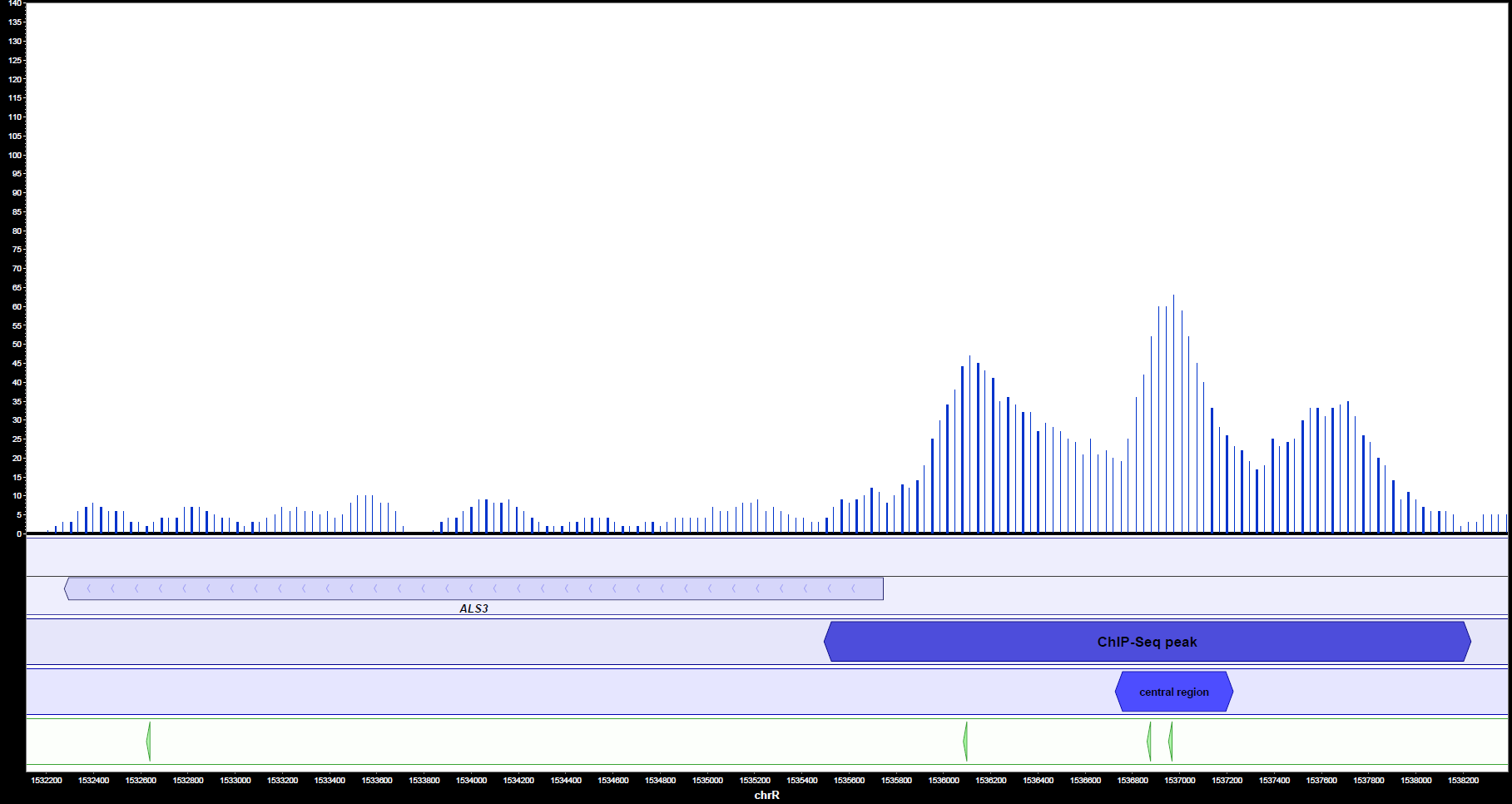
Overall, the Ahr1 motif was detected in the promoters of 37 virulence-related genes. The table below lists, for each gene, the motif with the highest MochiView score; if two binding sites share the same top score, both are shown.
| Gene name | Motif distance to gene (bp) | Motif strand | Motif score | Motif sequence |
|---|---|---|---|---|
| AHR1 | 5586 | - | 5.4 | GGCAACAATTACCGG |
| ALS1 | 1390 | - | 4.6 | GGAAACTTCAAACGA |
| ALS3 | 340 | + | 4.5 | TGCAAGTTAAACCGA |
| ALS4 | 1649 | - | 3.4 | CACAAGTGTAAGCGA |
| BCR1 | 2178 | - | 2.8 | AGAAAGGAAAAGCGA |
| BRG1 | 5765 | + | 5.1 | TGCAAGAATTACCGA |
| CDR1 | 1337 | + | 4.7 | ATCAACTATTGCCGA |
| CZF1 | 4304 | - | 2.4 | TGCAGTGGTAACCGA |
| DCK1 | 506 | + | 4.5 | GGAAAGTATAGTCGA |
| DEF1 | 1719 | - | 4.0 | GTCAACTTCTGACGA |
| DEF1 | 495 | - | 4.0 | GGAAATTAGAAACGA |
| EAP1 | 1204 | + | 4.5 | GGGAAGTTCAAGCGA |
| ECE1 | 2721 | + | 4.8 | GGGAAGAATTACCGA |
| EFG1 | 2311 | + | 5.0 | TGCAACTACAACCGA |
| FLO8 | 2066 | - | 3.5 | GGCAAGAAGTAGAGA |
| HGC1 | 11647 | - | 4.3 | GGAAAGTGGTAGCGA |
| HGT2 | 3442 | + | 4.9 | TGCAACTATTCGCGA |
| HWP1 | 1225 | - | 3.9 | GGCAAGTTTATCCGC |
| HYR1 | 1938 | + | 4.8 | AGCAATATTAGGCGA |
| IHD1 | 861 | + | 5.1 | TGCAACAATTACCGA |
| LMO1 | 179 | + | 4.4 | AGAAATTTTTAGCGA |
| MDR1 | 537 | - | 5.4 | GGTAACTATTGGCGA |
| NDT80 | 1567 | - | 5.1 | GGCAAGTTTAATCGA |
| RBT1 | 98 | - | 4.4 | GGTAAGATTTACCGG |
| RIM101 | 664 | - | 5.1 | AGCAAGTAGAGCCGA |
| SAP4 | 807 | - | 3.8 | AGCAATTTTAAGAGA |
| SAP5 | 1144 | + | 4.3 | GGCAATTTTAAGAGA |
| SAP6 | 833 | - | 3.5 | GGTAATTTTAAGAGA |
| SFL1 | 6551 | - | 5.1 | GGAAACTATTACCGG |
| SFL2 | 2733 | + | 4.0 | AACAAGTAGAGCCGA |
| SOD5 | 888 | + | 4.9 | GGCATCTTTTCCCGA |
| SOD5 | 1512 | + | 4.9 | GGAAAGTTGAAGCGA |
| STP2 | 915 | + | 2.9 | TGCAAGACTTGCAGA |
| TEC1 | 5005 | - | 4.8 | GGCAAGTATAAGCTA |
| UME6 | 15928 | + | 4.2 | AACAACTTTAAACGA |
| WOR1 | 5648 | - | 5.0 | AGCAAGTATAGCCGT |
| WOR2 | 1834 | + | 5.0 | GGCATCAATTACCGA |
Table 1: Ahr1 binding motif in the promoters of 37 virulence-associated genes, showing distance to transcription start site, strand and MochiView score.
These findings indicate that Ahr1 participates in regulating a wide range of virulence-associated processes, including hyphal growth, cell invasion, iron acquisition and host-cell damage, and that a binding site in its own promoter may even support a feedback mechanism.
Homology search and synteny
Homologues of AHR1 – as well as of ECE1 and ALS3 – can be found in the genomes of C. dubliniensis and C. tropicalis, two closely related and likewise pathogenic species. Pairwise alignments computed with T-Coffee (v. 11.0) show very high scores for AHR1 homologues (e.g. 992 for C. albicans AHR1 vs. C. dubliniensis Cd36_85930, 914 vs. C. tropicalis CTRG_02263) and similarly strong conservation for ECE1 and its homologues.[7]
Gene order (synteny) is also well conserved between these species, as visualised in the Candida Gene Order Browser (Figure 3, shown for AHR1), whereas the arrangement differs markedly from that in the non-pathogenic model fungus Saccharomyces cerevisiae.[8]

These observations suggest that similar regulatory mechanisms to those in C. albicans may also operate in these related pathogenic Candida species.
References
- [1] P. E. Sudbery: Growth of Candida albicans hyphae. Nat. Rev. Microbiol., 9:737–748, 2011. doi: 10.1038/nrmicro2636
- [2] K. Zakikhany et al.: In vivo transcript profiling of Candida albicans identifies a gene essential for interepithelial dissemination. Cell Microbiol., 9:2938–2954, 2007. doi: 10.1111/j.1462-5822.2007.01009.x
- [3] A. L. Mavor, S. Thewes, B. Hube: Systemic fungal infections caused by Candida species: epidemiology, infection process and virulence attributes. Curr. Drug Targets, 6:863–874, 2005. doi: 10.2174/138945005774912735
- [4] S. Ruben et al.: Ahr1 and Tup1 contribute to the transcriptional control of virulence-associated genes in Candida albicans. mBio, 11:2, 2020. doi: 10.1128/mBio.00206-20
- [5] P. Machanick, T. L. Bailey: MEME-ChIP: motif analysis of large DNA datasets. Bioinformatics, 27:1696–1697, 2011. doi: 10.1093/bioinformatics/btr189
- [6] O. R. Homann, A. D. Johnson: MochiView: versatile software for genome browsing and DNA motif analysis. BMC Biol., 8:49, 2010. doi: 10.1186/1741-7007-8-49
- [7] C. Notredame, D. G. Higgins, J. Heringa: T-Coffee: A novel method for fast and accurate multiple sequence alignment. J. Mol. Biol., 302(1):205–217, 2000. doi: 10.1006/jmbi.2000.4042
- [8] S. L. Maguire et al.: Comparative genome analysis and gene finding in Candida species using CGOB. Mol. Biol. Evol., 30(6):1281–1291, 2013. doi: 10.1093/molbev/mst042