
With tailored data management and database development, we help you to keep the rapidly growing data volumes from your biological and medical experiments securely, consistently and efficiently usable in the long term. We develop central, role-based web interfaces (front end) and robust relational database systems (back end) so that both your complex measurement data and all associated metadata can be collected at one location and accessed from any site. Using easy-to-use input templates and standardized ontologies, we ensure consistent, high-quality data entry. The intuitive web interface enables your entire team or research consortium not only to access data securely with the appropriate permissions, but also to use integrated filtering and visualization tools to compare results such as gene or protein lists directly online, generate interactive plots and link them seamlessly to external databases.
(Status: July 2017)
Background
Increasingly, biological and medical experiments generate large amounts of data. These data are analyzed with respect to the corresponding research question (an example of such an analysis conducted by BioControl Jena is omics analysis). After completion of the experiment and analysis, it must be ensured that both the data themselves and all relevant metadata remain available. In large research consortia, at least the metadata should be stored centrally and made accessible to all members via access control. The creation of a database (back end) and a web interface (front end) for accessing these data is illustrated below by means of one example. This web-based solution is actively used by a biological research consortium (interim status: July 2017).
Back end
Data acquisition
Microsoft Excel® is a widely used tool for data acquisition and can be adapted to different applications using VBA. Therefore, Excel® templates were designed for capturing metadata from RNA-seq, microarray and LC-MS/MS experiments. These templates are filled in by the experimentalists in collaboration with the bioinformaticians responsible for data analysis and are then translated into the database using a parser.
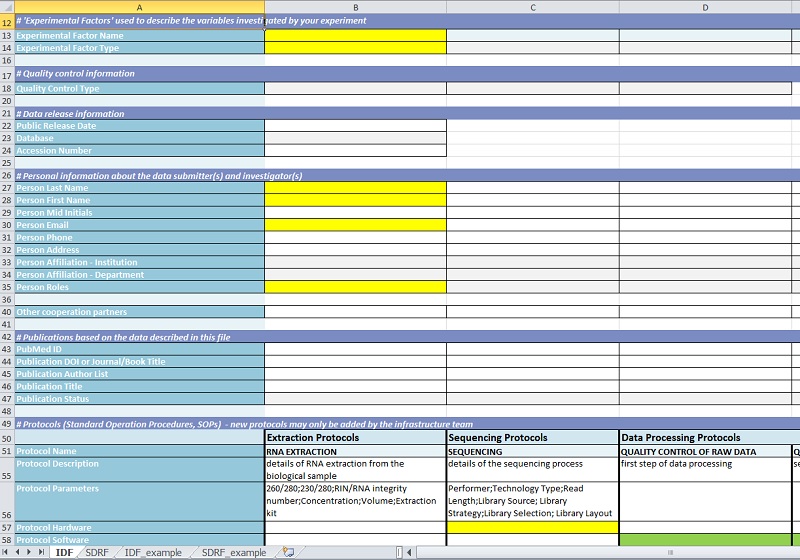
The first sheet of each file is used to record general experiment-related information such as experiment title and description, experimental parameters and involved persons:
The second sheet collects information on the individual biological samples (e.g. organism and strain, experimental conditions, data analysis parameters). Depending on the experiment type, this can be very extensive. Therefore, information that is identical for all samples can be copied into all relevant rows with a single click using a macro, and only the sample-specific data need to be entered individually. Most entries are implemented via drop-down lists in order to obtain a standardized vocabulary. Established ontologies (e.g. MGED or PSI-MS ontology) are used as reference to ensure comparability with other public databases. The actual experimental data generated are referenced in the template only via their storage location; the template itself contains metadata only.
Data storage
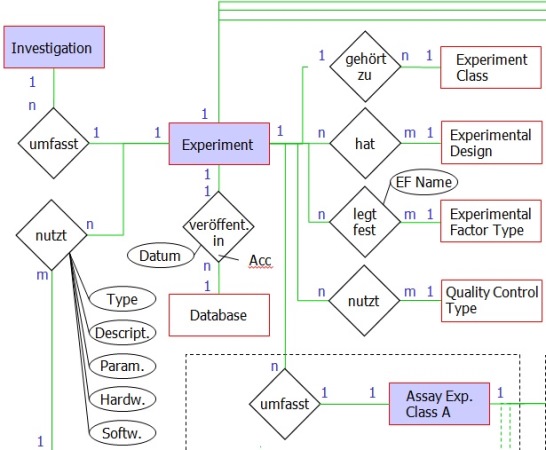
Object-relational databases are now the standard for efficient storage of large data volumes, in particular with respect to storage space and access time. Based on positive experience in previous projects and its suitability for this application, PostgreSQL was chosen as the database management system. Prior to implementing the database, the data structure must be carefully designed in order to accommodate the diversity of biological data and ensure maximum extensibility. The data structure used here is aligned with the templates used for data acquisition and is optimized for storing metadata from high-throughput experiments.
Front end
A web-based solution is particularly suitable for accessing the database, as several institutions generate data and need to access them from different locations. Database access itself was implemented using PHP, while the web interface was created using HTML, CSS and JavaScript. With the appropriate access rights, a user can browse all relevant metadata of an experiment online (the experiment title was removed in the screenshot, since the data are not publicly accessible).
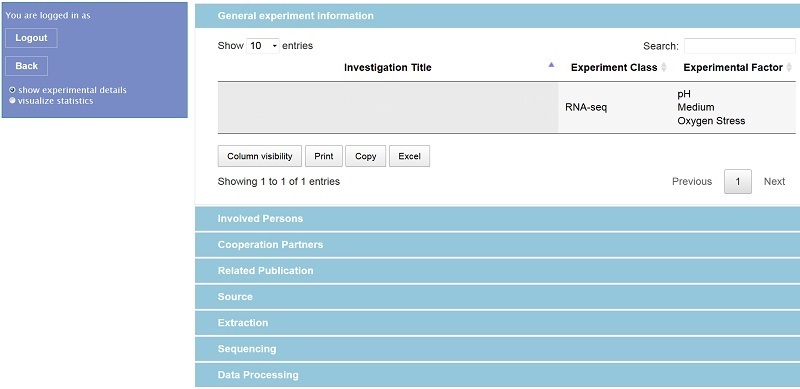
The corresponding experimental raw data are only linked (as in the templates), so that the experimentalists need to be contacted to grant access to their data. Individual results (i.e. gene or protein lists) from the analyses of different conditions of an experiment are provided in the web interface in table form or as plots:
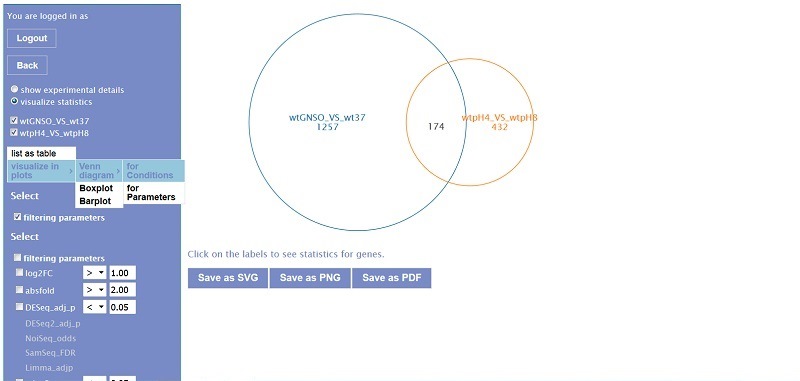
Using the filter and visualization parameters, tables and plots can be adjusted to, for example, test different thresholds for fold changes or p-values, or to compare different experimental conditions and software settings. The gene lists are also linked to external databases. In this way, the maximum amount of available information can be collected and exploited for each experiment.
This brief description of a current application example illustrates only a fraction of the possibilities, which are primarily driven by user requirements. For instance, the described web interface is planned to be extended with an upload form as well as interfaces to external tools for genome visualization and network analysis.
References
- S. Schäuble, D. Albrecht-Eckardt and G. Panagiotou: FungiNetDB: A Uniform (pre-)processing Platform for Fungal Expression Data. In: microLife, 7:uqag012, 2026. doi: 10.1093/femsml/uqag012